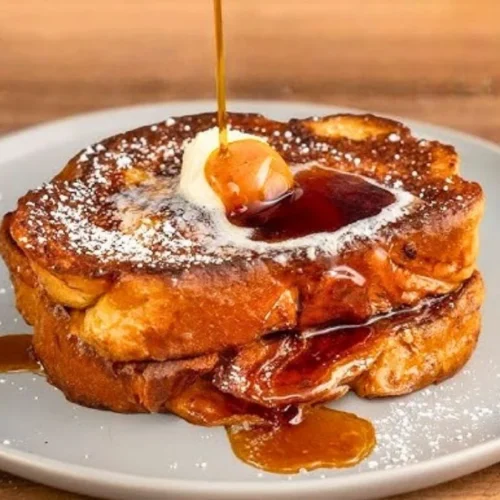
Frank Proto French Toast Recipe
If you’ve ever wondered how professional chefs make French toast that’s impossibly creamy inside with a golden, buttery crust, Frank Proto’s French toast recipe is your answer.
Ingredients
- 1 loaf challah bread
- 2 cups heavy cream
- 4 large eggs
- 2 –3 tablespoons sugar
- 1 teaspoon vanilla extract
- 1 –2 tablespoons brandy
- Zest of 1 orange
- ⅛ –¼ teaspoon freshly grated nutmeg
- Pinch of kosher salt
- Salted butter
- Real maple syrup
- Powdered sugar
- Extra whipped salted butter
Instructions
- Slice your challah loaf into ¾ to 1-inch thick pieces-about “two fingers” wide. This thickness is crucial for achieving that signature custardy interior. Lay the slices on a wire rack or baking tray and let them dry out overnight at room temperature. This step allows the bread to absorb maximum custard without falling apart. If you’re short on time, place the slices in a 200–250°F oven for 15–20 minutes until lightly stale but not toasted.
- In a wide, shallow bowl large enough for soaking bread, combine 2 cups heavy cream, 4 eggs, 2–3 tablespoons sugar, 1 teaspoon vanilla extract, 1–2 tablespoons brandy, orange zest, nutmeg, and a pinch of salt. Use an immersion blender or whisk vigorously until the mixture is completely smooth and homogeneous. Make sure there are no clumps of nutmeg or streaks of egg-the custard should be velvety and uniform in color.
- Place 2–3 slices of dried challah into the custard (avoid overcrowding). Let them soak for 20–30 minutes, flipping occasionally to ensure even absorption. The bread is ready when it feels soft and spongy throughout. Test by gently squeezing-custard should ooze out like a saturated sponge, and the center should not feel firm or dry. This extended soaking time is what makes Frank Proto French toast exceptionally creamy.
- Heat your non-stick or cast-iron skillet over medium-low heat. Add 1–2 tablespoons of salted butter and let it melt slowly-it should not sizzle immediately. Gently lift each soaked slice from the custard, allowing excess to drip off (don’t squeeze hard). Place in the pan where the butter should form small, gentle bubbles around the edges. Cook for 4–5 minutes on the first side until golden brown, then flip and cook for 5–7 more minutes until the center is fully set. Press the center gently-no liquid should squeeze out, but it should still feel soft and yielding.
- Transfer the French toast to plates while piping hot. Top each slice with a pat of whipped salted butter, drizzle generously with real maple syrup, and dust with powdered sugar. Frank Proto French toast tastes best eaten immediately, straight from the pan when the exterior is at its crispiest and the interior is still steaming.
Notes
Store leftover Frank Proto French toast in an airtight container in the refrigerator for up to 3 days. Reheat in a 350°F oven for 8–10 minutes or in a toaster oven until warmed through and the exterior crisps up again. Avoid microwaving, as it makes the texture soggy.