Paul Hollywood Sourdough Bread Recipe
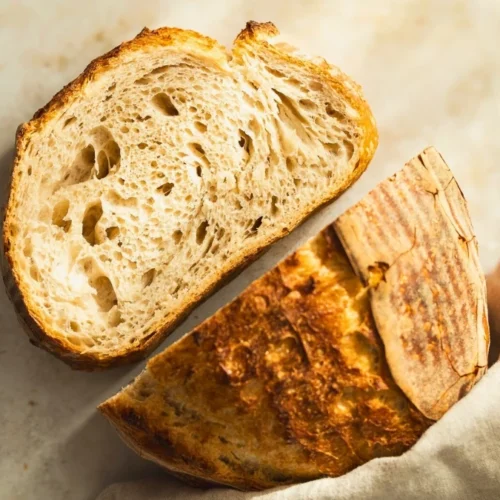
There’s something magical about baking your own sourdough bread, especially when you’re following a Paul Hollywood sourdough recipe. This legendary baker has perfected the art of creating crusty, tangy loaves with that signature open crumb structure.
Ingredients
- 100 g active sourdough starter bubbly and at peak activity
- 375 ml tepid water divided: 350ml + 25ml
- 500 g strong white bread flour
- 12 g salt about 2 teaspoons
Instructions
- Place your 100g sourdough starter in a large mixing bowl. Add 350ml tepid water and whisk thoroughly with a balloon whisk until well combined and slightly frothy. Add all 500g of strong white bread flour at once. Mix quickly using your hands or a wooden spoon to form a scrappy, shaggy dough.
- The dough will look rough and uneven-that’s perfectly fine. If it seems too stiff or dry, add a tablespoon of water at a time. Ensure no dry flour patches remain. Cover and rest for 30 minutes. This autolyse period allows the flour to fully hydrate, making kneading much easier.
- Dissolve the 12g salt in the remaining 25ml tepid water. Pour this salt solution over your rested dough. Now begins the folding technique: grab one edge of the dough and fold it into the center. Rotate the bowl 90 degrees and repeat. Continue this folding motion, turning the bowl as you go, for about 30 seconds until the salt water is fully incorporated. The dough will feel slippery at first. Rest the dough for 10 minutes.
- This is where the Paul Hollywood sourdough recipe technique really shines. Perform another series of folds-grab the edge, fold to center, rotate bowl, repeat for 30 seconds. If the dough sticks to your hands, dampen them with water. Rest for 10 minutes. Repeat this folding and resting cycle 8 times total. Yes, it seems repetitive, but each 30-second folding session builds gluten structure without traditional kneading. After the final fold, you’ll notice the dough has transformed-it’s smoother, more elastic, and holds its shape beautifully.
- Lightly oil a piece of cling film and cover your bowl. Leave the dough to rise at room temperature until doubled in size-approximately 2 hours in a warm kitchen (21-24°C/70-75°F). Alternatively, you can refrigerate it overnight for a slower fermentation that develops deeper flavor. The dough should look puffy and airy when ready.
- Lightly flour your work surface. Using a dough scraper or your hands, gently turn the risen dough out onto the counter. Handle it delicately to preserve the air bubbles. Shape it into a rough rectangle. Fold the top third down to the middle, then fold the bottom third up over it (like folding a business letter). Next, fold the left side to the center, then fold the right side over it. Flip the loaf so all folds are underneath. Cover lightly with oiled cling film and rest for 20 minutes.
- Turn your dough smooth-side down onto a lightly floured surface. Repeat the exact same folding process: top to middle, bottom over it, left to center, right over it. Flip the dough so the smooth surface is on top and the seams are underneath. This creates surface tension that helps the loaf rise upward rather than spreading outward.
- Generously flour a clean tea towel and line a bowl with it (or use a well-floured proving basket/banneton). Place your shaped dough into the bowl smooth-side DOWN (seams facing up). Cover with oiled cling film. Leave to prove until doubled in size-when you gently press a finger into the edge, the indentation should remain. This typically takes 3-4 hours at room temperature or can be done overnight in the refrigerator for enhanced flavor.
- Thirty minutes before baking, preheat your oven to 225°C/205°C fan/gas mark 7½ (437°F). Place an empty roasting tin on the bottom rack of the oven-this will create crucial steam. Lightly flour a baking sheet and set it aside.
- When your dough has completed its final proof, carefully pour 500ml boiling water into the hot roasting tin in the oven (stand back from the steam!). Remove the cling film from your proved dough. Place the floured baking sheet over the bowl and confidently flip it over so the dough lands smooth-side UP on the sheet. Immediately score a decorative pattern on top using a very sharp knife or bread lame-classic options include a single slash, cross pattern, or wheat stalk design. Work quickly and decisively.
- Carefully open the oven door, minding the steam. Slide the baking sheet onto the upper-middle shelf. Close the door quickly to trap the steam. Bake for 25-30 minutes total. After 15 minutes, rotate the bread 180 degrees for even browning. The finished loaf should be deeply golden-brown with a crackling crust. Tap the bottom-it should sound hollow. If it needs more time, reduce heat to 180°C/160°C fan/gas 4 and bake for 5-10 minutes more.
- Transfer your beautiful Paul Hollywood sourdough bread to a wire cooling rack immediately. Resist the temptation to slice it! Allow it to cool completely for at least 1 hour. This cooling period allows the interior crumb structure to set properly and prevents a gummy texture.
Video
Notes
Store your Paul Hollywood sourdough bread at room temperature in a paper bag or bread box for up to 3 days-avoid plastic bags which make the crust soft. For longer storage, slice and freeze for up to 3 months in an airtight container. Refresh day-old bread by sprinkling with water and warming in a 180°C oven for 5-10 minutes to restore the crust’s crackle.