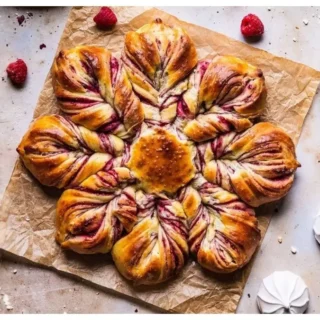
Paul Hollywood Cinnamon Snowflake Recipe
If you’ve ever watched The Great British Bake Off and marveled at Paul Hollywood’s stunning cinnamon snowflake bread, you’re in for a treat.
Ingredients
- 1 cup warm whole milk 110°F (240mL)
- 1 0.25-ounce packet instant yeast
- 5 tablespoons unsalted butter melted
- ¼ cup granulated sugar 50g
- 1 large egg room temperature
- 3¾ cups all-purpose flour 450g
- 1 teaspoon salt
- ½ cup granulated sugar 100g
- 1 tablespoon ground cinnamon
- 3 tablespoons unsalted butter melted
- 1 large egg
- 1 teaspoon water
- Confectioners’ sugar for dusting
Instructions
- In your stand mixer bowl, combine the warm milk (ensure it’s 110°F too hot kills yeast, too cold won’t activate it) with the instant yeast. Let this mixture stand undisturbed for about 10 minutes until it becomes very foamy and fragrant. This “blooming” process confirms your yeast is active and ready to work its magic.
- Once the yeast mixture is beautifully foamy, add the melted butter, granulated sugar, and room-temperature egg. On top of these wet ingredients, carefully add all the flour and salt. Attach the dough hook to your mixer and begin mixing on low speed. Let the ingredients combine until a shaggy dough starts forming, about 2 minutes.
- Increase the mixer speed to medium-low and continue kneading for 8 to 10 minutes. Watch as the dough transforms into a smooth, elastic ball that pulls away from the bowl’s sides (though it may still stick slightly to the bottom). This extended kneading develops the gluten structure essential for that perfect fluffy texture.
- Shape your dough into a smooth ball and place it in a lightly oiled bowl, turning once to coat. Cover with plastic wrap or a damp tea towel and let it rise in a warm, draft-free spot until doubled in size, approximately 1 hour.
- While the dough rises, prepare your filling by whisking together the granulated sugar and cinnamon in a small bowl until evenly combined. Set aside. Have your melted butter ready for brushing.
- Once risen, punch down the dough to release air bubbles and turn it out onto a lightly floured surface. Divide it into 4 equal pieces (use a kitchen scale for precision each should weigh about 165g). Shape each piece into a smooth ball.
- Roll one dough ball into a thin, roughly 12-inch circle. If your dough keeps shrinking back, let it rest for 5 minutes this allows the gluten to relax. For easier rolling, try working on an unfloured surface. Transfer this circle to a sheet of parchment paper.
- Lightly brush the dough circle with melted butter, leaving a ½-inch border around the edge. Sprinkle with one-third of your cinnamon-sugar mixture, distributing it evenly.
- Roll out a second dough ball to the same 12-inch size and carefully place it on top of the sugared layer. If the edges don’t align perfectly, gently pinch the top layer’s edge to the bottom layer to maintain the circular shape. Brush with butter and add another third of the cinnamon sugar.
- Repeat this layering process with the third dough ball butter, cinnamon sugar. Roll out your fourth and final dough ball and place it on top. Now trim any uneven edges with a knife or pastry cutter to create a clean 10- to 11-inch circle.
- Place a 3-inch round cookie cutter or small bowl in the center of your layered dough stack this will be your guide. Using a pastry cutter or very sharp knife, cut the circle into quarters, starting from the edge and stopping at the edge of the bowl. Then cut each quarter in half, and each of those pieces in half again. You should now have 16 triangular strips radiating from the center, all connected at the bowl.
- Here’s where the magic happens! Grab two adjacent dough strips, one in each hand. Twist them away from each other three times, creating a spiral effect. Lay them back down and pinch the ends together firmly. Repeat this twisting motion all around the circle with each pair of strips. You’ll end up with 8 beautiful twisted points forming a stunning star pattern. Carefully remove the cookie cutter from the center.
- Transfer the entire snowflake (still on the parchment paper) onto a rimmed baking sheet. Cover loosely with plastic wrap or a tea towel and let it rise until noticeably puffed, about 20 to 30 minutes. Meanwhile, preheat your oven to 375°F.
- Beat together the egg and water until well combined to create an egg wash. If any of your twisted points have separated during rising, gently pinch them back together. Using a pastry brush, coat the entire surface of the puffed snowflake with the egg wash this creates that gorgeous golden sheen.
- Bake for 25 minutes, or until the paul hollywood cinnamon snowflake bread turns a beautiful golden brown. If you notice it browning too quickly, loosely tent with aluminum foil after 15 minutes. The bread is done when it sounds hollow when tapped and reaches an internal temperature of about 190°F.
- Let the snowflake cool on the baking sheet for 10 minutes, then transfer to a wire rack. Just before serving, dust generously with confectioners’ sugar for that signature snowy appearance.
Video
Notes
Store your cooled cinnamon snowflake bread in an airtight container or wrapped tightly in plastic wrap at room temperature for up to 2 days. For longer storage, freeze for up to 3 months. Reheat in a 300°F oven for 10 minutes to restore freshness.